


Recently, I received a message that reminded me why lived experience matters so much.
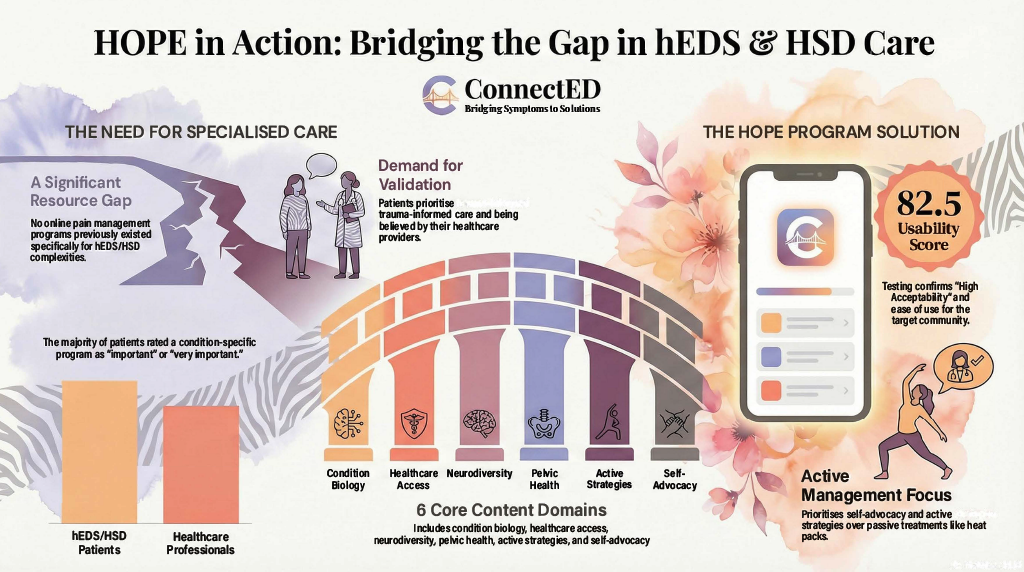
Last year, I took part in a research study exploring the design of a digital pain management program for people with Hypermobile Ehlers-Danlos Syndrome (hEDS) and Hypermobility Spectrum Disorder (HSD).
That study has now been published in Disability and Rehabilitation, and it’s already led to the development of a new program: the HOPE Program — built specifically for our community.
What stood out to me most in the findings?
👉 The deep need for personalisation, validation, and trauma-informed care.
👉 The demand for real tools that see the whole person, not just the pain.
👉 The acknowledgment that we are not always believed — but we should be.
These themes are the very same ones that drive ConnectED.
💡 This is exactly what we’re building:
- A platform that starts with trust
- That understands the overlap of conditions like hEDS, POTS, and MCAS
- And that uses evidence, empathy, and lived experience to help people take back control of their health journey
I’m proud to have contributed to this incredible project, and I’m even more proud to be building alongside it. Let’s keep turning lived experience into action.
Download the ConnectED App today via the Apple App Store or Google Play.
You are not alone—and you are not overreacting.
Medical Disclaimer
This content is for informational purposes only and is not a substitute for professional medical advice, diagnosis, or treatment. Always seek the advice of your doctor or qualified health provider regarding any medical condition.
FAQ
What is Hypermobile Ehlers-Danlos Syndrome misdiagnosis?
It’s when hEDS symptoms are mistaken for other conditions like anxiety, depression, or IBS, delaying correct treatment.
Why is hEDS often misdiagnosed?
Because it affects multiple systems and lacks a definitive test, symptoms can resemble unrelated physical or mental health conditions.
How long does it take to get diagnosed with hEDS?
On average 10–12 years, sometimes longer, due to low awareness among healthcare providers.
Can the ConnectED App help my doctor diagnose hEDS?
While not a diagnostic tool, it provides a structured symptom report to support the diagnostic
process.
What other conditions are linked with hEDS?
Common overlaps include POTS, MCAS, neurodivergence, and post-viral syndromes like Long COVID.
About the Author
Tracy Finnegan, RN, BAppSc is the Founder and Managing Director of ConnectED. A former ICU nurse and scientist, Tracy has lived experience with hEDS, POTS, MCAS, and Long COVID. After decades of misdiagnoses, she created the ConnectED App to empower patients to track symptoms, identify patterns, and advocate for accurate diagnoses and better care. Tracy brings firsthand experience, clinical expertise, and a patient-focused tool to support others.